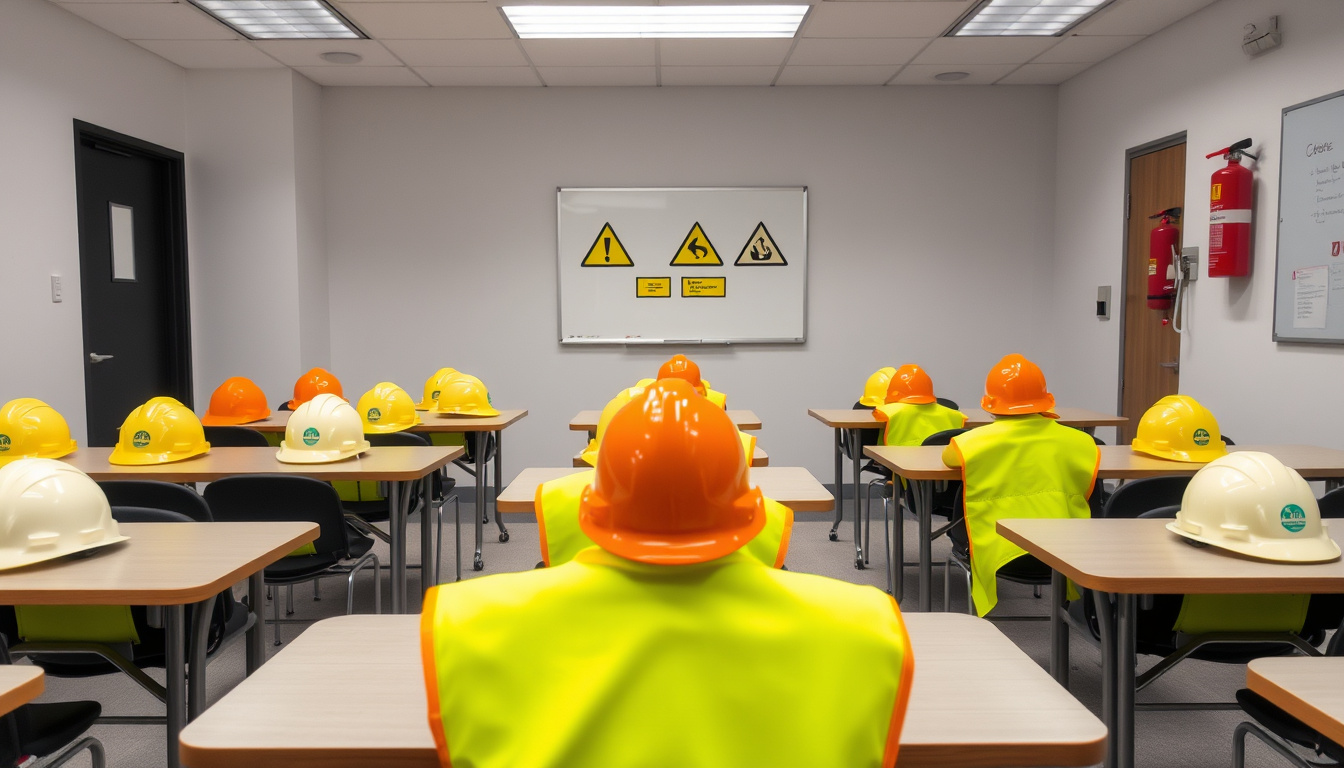
Health and Safety Training: What It Means and Why It Matters


Over 30,000 non-fatal workplace injuries were reported in Ireland in 2022—and research suggests proper training can cut that number by up to 30%. The Safety, Health and Welfare at Work Act 2005 makes health and safety training a legal obligation for Irish employers, not an optional extra.
Workplace injuries (Ireland, 2022): Over 30,000 non-fatal injuries reported ?
Reduction with proper training: Up to 30% fewer incidents ?
Mandatory core modules (HSE Ireland): 3 modules for clinical and desk-based roles
Quick snapshot
- Irish employers must provide training under the Safety, Health and Welfare at Work Act 2005 (Section 8).
- The Health and Safety Authority (HSA) maintains a directory of approved providers.
- Manual handling training is mandatory for many roles across Irish workplaces. (Safety, Health and Welfare at Work Act 2005)
- Exact cost of HACCP courses varies widely (€50–€500) with no standardised fee .
- Training hours required per role are not standardised across all Irish sectors .
- The 1988 Bill paved the way for the 1989 Act, which was modernised by the 2005 Act—still the backbone of current Irish workplace safety law.
- Online and blended health and safety training has expanded significantly since the 2010s. (2005 Act)
- Employers must review and update risk assessments regularly as regulations evolve .
- Refresher training intervals for certificates like manual handling are a common compliance question heading into 2025 .
Key facts about Ireland's mandatory health and safety training framework are summarised in the table below.
| Label | Value |
|---|---|
| Legal basis | Safety, Health and Welfare at Work Act 2005 |
| Enforcing body | Health and Safety Authority (HSA) Ireland |
| Mandatory training for healthcare staff | 3 core modules per HSE National Health and Safety Function guidance |
| Common certification | QQI Level 5 Health & Safety at Work (component 5N1794) |
What Are the 5 Basic Safety Trainings?
Irish employers must ensure staff receive training that matches their roles and the specific hazards they face. The Health Service Executive (HSE) guidance specifies that training is required either by legislation or by a formal training needs analysis—and must be provided to new employees and whenever work, equipment or technology changes.
Mandatory training for desk-based staff
- Fire safety and emergency evacuation procedures
- Display screen equipment (DSE) training to prevent musculoskeletal issues
- General workplace hazard awareness and risk assessment
Clinical safety training for healthcare workers
- Basic life support and first aid
- Manual handling of patients and equipment
- Infection control and sharps handling
The requirement to match training to actual workplace risks means Irish employers cannot apply a one-size-fits-all approach to compliance.
Fire safety and emergency preparedness
- Emergency evacuation plans and assembly points
- Fire extinguisher use and fire blanket procedures
- Regular fire drill participation
The implication: Fire safety training addresses one of the most common causes of injury across Irish workplaces, making it a universal priority regardless of sector.
Manual handling training
- Lifting techniques for heavy loads
- Pushing and pulling hazards
- Team handling for awkward or bulky items
What this means: Manual handling injuries remain preventable when employers ensure staff receive role-specific training and refresher courses at appropriate intervals.
Hazard identification and risk assessment training
- How to spot workplace hazards before incidents occur
- Recording and reporting procedures
- Understanding the hierarchy of controls
The pattern: Risk assessment training gives employees the tools to identify hazards proactively rather than reacting after an incident has occurred.
Irish law doesn't leave training to employer discretion—it specifies that information, instruction, training and supervision must match the actual risks employees face on the job. Section 8 of the 2005 Act makes this a general duty, with the HSA empowered to enforce it across all sectors.
What Are the 5 Basic Safety Rules?
Beyond formal training courses, Irish workplaces operate under a set of universal safety rules that apply across industries. HSA-linked guidance emphasises that both physical and mental well-being of staff must be protected, which requires consistent adherence to these principles.
Always use personal protective equipment (PPE)
- PPE is the first line of defence against identified hazards
- Equipment must be suitable, properly maintained, and correctly used
- Training on PPE use is itself a mandatory component of many safety programmes
Maintain clear work areas and good housekeeping
- Slips, trips and falls remain among the most common causes of Irish workplace injuries
- Walkways must remain unobstructed; spills addressed immediately
- Regular cleaning schedules reduce biological and physical hazards
Report all hazards and incidents immediately
- Employees must raise concerns about dangerous conditions without delay
- Near-misses should be documented even when no injury occurs
- Irish employers must keep injury records for a minimum of 10 years
Follow safe work procedures and permit systems
- Specific tasks like working at height or hot work require formal permits
- Permit systems exist to ensure controls are in place before high-risk work begins
- Supervisors must verify workers are trained and authorised for the task
Never take shortcuts with safety protocols
- Time pressure is a documented factor in many workplace accidents
- Experienced workers setting poor examples undermines safety culture for everyone
- The consequences of non-compliance include enforcement action from the HSA and potential prosecution
What this means: These five rules aren't suggestions—they form the behavioural backbone that formal training courses are designed to instil. A worker who completes a manual handling course but ignores unsafe load practices defeats the purpose of the training entirely.
NISO identifies these five rules as the most commonly delivered safety trainings in Irish workplaces, because regulators and insurance providers treat them as non-negotiable.
What Are the 5 Steps in Health and Safety?
Irish health and safety practice follows a structured five-step process that employers must document. The Global People Strategist notes that Irish policy obliges employers to identify hazards, carry out risk assessments, and implement control measures backed by a written safety statement.
Identify hazards in the workplace
- Walk through all work areas and observe tasks as they are actually performed
- Consult with workers—they often notice hazards that managers overlook
- Review accident and near-miss records to identify recurring problem areas
Assess the risks associated with each hazard
- Consider who might be harmed and how seriously
- Evaluate the likelihood of harm occurring in normal and abnormal conditions
- Prioritise hazards based on severity and frequency to focus resources
Control the risks (hierarchy of controls)
- Eliminate the hazard entirely where possible (e.g., remove toxic chemicals from the process)
- If elimination isn't feasible, substitute with a less dangerous alternative
- Apply engineering controls (e.g., machine guards), then administrative controls (e.g., job rotation), and finally PPE as the last resort
Record findings and implement measures
- Document the risk assessment in writing—Irish law requires a formal safety statement
- Communicate control measures to all affected workers
- Assign responsibilities and deadlines for implementing outstanding measures
Review and update the risk assessment regularly
- Reassess when equipment, processes or personnel change
- Incorporate lessons from any incidents or near-misses that occur
- The safety statement is a living document, not a one-time compliance box to tick
The pattern: These five steps work as a continuous cycle. Even if your current risk assessment is sound, a change in equipment or work methods can invalidate your controls overnight—which is why the HSA expects documented review processes, not static paperwork.
"A systematic approach reduces accidents and ensures legal compliance." — HSA spokesperson
What Are the 5 C's of Safety?
The 5 C's of safety provide a cultural and organisational framework that complements the procedural steps above. They are not a legal standard but a best-practice model that many Irish organisations adopt to build a robust safety culture.
Care – prioritising well-being
- Leaders demonstrate that employee welfare is a genuine priority, not a bureaucratic obligation
- Care extends beyond physical safety to include mental health and ergonomic comfort
Collaboration – teamwork in safety
- Safety is a shared responsibility across all levels of the organisation
- Joint safety committees and worker representation strengthen buy-in
- The HSA directory of approved training providers lists providers offering specific training on safety representation
Communication – clear reporting and instructions
- Hazards, procedures and changes must be communicated in a format workers understand
- Language barriers require additional attention in diverse Irish workplaces
- Reporting channels must be visible, accessible and free from retaliation
Commitment – leadership and worker buy-in
- Management must allocate time and resources to safety, not just talk about it
- Workers commit by following procedures and raising concerns proactively
- Training from accredited providers like those listed in the HSA provider directory reinforces this commitment
Continuous improvement – learning from incidents
- Every accident or near-miss is an opportunity to improve systems
- Post-incident reviews should ask "why" multiple times to get to root causes
- Refresher training and updated procedures reflect the latest learning
The 5 C's framework is widely endorsed but legally non-binding. Irish employers should treat it as a supplement to, not a substitute for, the specific training mandates and documentation requirements under the 2005 Act.
The implication: An organisation with an excellent safety culture but no documented risk assessment still fails legal compliance under Irish law.
What Are the 4 Principles of HSE?
The Health and Safety Executive (HSE) framework—applied in Irish regulations through the Safety Statement—sets four core principles that guide the design of effective safety management systems. HSE guidance for Ireland's health service differentiates mandatory training for desk-based and clinical staff, illustrating how these principles apply across risk profiles.
Risk assessment as the foundation
- Every safety initiative starts with understanding what could go wrong and who might be harmed
- Assessments must be documented, communicated to workers, and kept up to date
- The primary Irish workplace safety legislation makes formal risk assessment a legal requirement
Proactive prevention over reactive measures
- Waiting for accidents to happen before acting is both unethical and costly
- Proactive measures include regular equipment maintenance, pre-task briefings, and safety audits
- The hierarchy of controls—elimination, substitution, engineering, administrative, PPE—reflects this principle
Worker participation and consultation
- Employees closest to the work often have the clearest understanding of the risks
- Consultation must be genuine, not a checkbox exercise; workers must feel free to raise concerns
- The National Irish Safety Organisation (NISO) offers specific courses on health and safety representation
Continuous improvement through monitoring and review
- Safety performance must be measured, reviewed and acted upon
- Key performance indicators might include accident rates, near-miss reports, and training completion rates
- The safety statement should be reviewed at least annually or when significant changes occur
"All staff must complete fire safety, manual handling, and basic life support." — HSE National Health and Safety Function guidance
The implication: These four principles translate directly into concrete obligations. An employer who can demonstrate systematic risk assessment, worker consultation, and documented review is far better positioned if the HSA investigates an incident in their workplace.
Frequently asked questions
How much is a HACCP course?
HACCP course costs in Ireland vary significantly, ranging from approximately €50 for basic online modules to €500 or more for comprehensive classroom-based certification programmes. The wide range reflects differences in course depth, accreditation level, and delivery format. Food businesses should verify that their chosen provider meets Food Safety Authority of Ireland (FSAI) requirements.
Is online health and safety training accepted in Ireland?
Yes. Online health and safety training is widely used and accepted in Ireland. Providers such as GTSS offer self-paced e-learning courses that can be completed on mobile, tablet or desktop with certification issued upon completion. However, some high-risk activities (e.g., working at height, confined spaces) may require in-person practical assessment to satisfy regulatory requirements.
What is the Springboard+ initiative for health and safety courses?
Springboard+ is an Irish government initiative that provides free or heavily subsidised education and training programmes for unemployed people and those in certain employment situations. Health and safety courses at various QQI levels—including Higher Diplomas and degree programmes—have been supported through Springboard+, making career transitions into occupational safety more accessible.
Do I need a Level 7 health and safety course to work in construction?
Safe Pass is the mandatory entry requirement for construction workers on building sites in Ireland, not a Level 7 qualification. However, site managers, safety officers, and supervisors often pursue higher qualifications such as the NEBOSH National General Certificate or QQI Level 7+ awards to advance their careers and meet employer expectations. Irish Manual Handling lists NEBOSH, IOSH Managing Safely, and QQI Safety and Health at Work as common career-building certifications.
Where can I find free health and safety training in Ireland?
The HSA provider directory lists approved training organisations, some of which offer free awareness modules. Springboard+ funded courses can also provide free or subsidised access to accredited programmes. Employers should check with their industry representative bodies—NISO, for example, offers short courses that may be partially funded for member organisations.
How often must I renew my manual handling certificate?
Irish law does not prescribe a fixed renewal interval for manual handling certificates, but industry best practice recommends refresher training every three years. Some employers and sectors apply stricter intervals based on their risk assessments. The Cpl Institute notes that the QQI Level 5 Safety and Health at Work component 5N1794 is delivered over four days online as an entry-level accredited course.
What is the difference between a safety statement and a risk assessment?
A risk assessment is the analytical process of identifying hazards and evaluating risks in your workplace. The safety statement is the written document that records the outcomes of that assessment and states how you will manage those risks going forward. Under the Safety, Health and Welfare at Work Act 2005, every employer must have a written safety statement—and that document must be based on formal risk assessments. Think of the risk assessment as the audit and the safety statement as your documented response.
For Irish employers, the choice is straightforward: invest in proper, accredited health and safety training now, or face the consequences of preventable accidents, HSA enforcement action, and potential prosecution later. Workers, meanwhile, should treat every mandatory module as an investment in their own safety—one that pays dividends every day they go home uninjured.